
Dexter Senior Center
Rethinking senior nutrition services through design research

timeline:
May 2026 - august 2026
Service Design
User Research
The Brief
For 12 weeks during the summer of 2026 I was a Design Research Intern at the d-mix lab. During my time I worked on two main projects, senior nutrition service design with Dexter Senior Center, and AI life-planning research with Rejara. This case study will focus on my involvement with the senior nutrition research and service design with Dexter Senior Center.
Special thanks to Dr. Sheng-Hung Lee Director of the d-mix lab and Anna Pekrul Executive Director of Dexter Senior Center for making this all possible!
my role
Where do I sit in the timeline?
The project with Dexter Senior Center is expected to run 2 years; however, my involvement was primarily in the research and early ideation stage.

problem
Understanding the gaps
Anna the Executive Director of Dexter Senior Center came to us with a list of problems she noticed about the Senior Nutrition Program.
“The most significant challenge we see is participation tied to food quality and overall client experience. Nutrition programs are only effective if people actually want to engage with them.”
No emergency meal distribution plan
Weekend meal coverage gaps
High demand and limited capacity
Inconsistent attendance
volunteer vs. paid worker models
Anna Pekrul
Executive Director of Dexter Senior Center
Nutrition for seniors is important for…
Physical Wellness
Preserves muscles and bones, keeping seniors mobile.
Cognitive Health
Helps protect against memory loss and confusion
Mental Wellbeing
Supports mood, and shared meals fight isolation.
Building for a longevity society
The global population is aging at an unprecedented rate. The d-mix lab is committed to shape this emerging longevity society by mixing design, evidence-based research, service innovation, and emergent technologies, to build healthy and equitable multi-generational products, environments, and cultures.
approach
Use a design research workshop to understand the experiences of older adults in Dexter Senior Center's nutrition program and find opportunities to improve their experience
workshop
A quick trip to Michigan
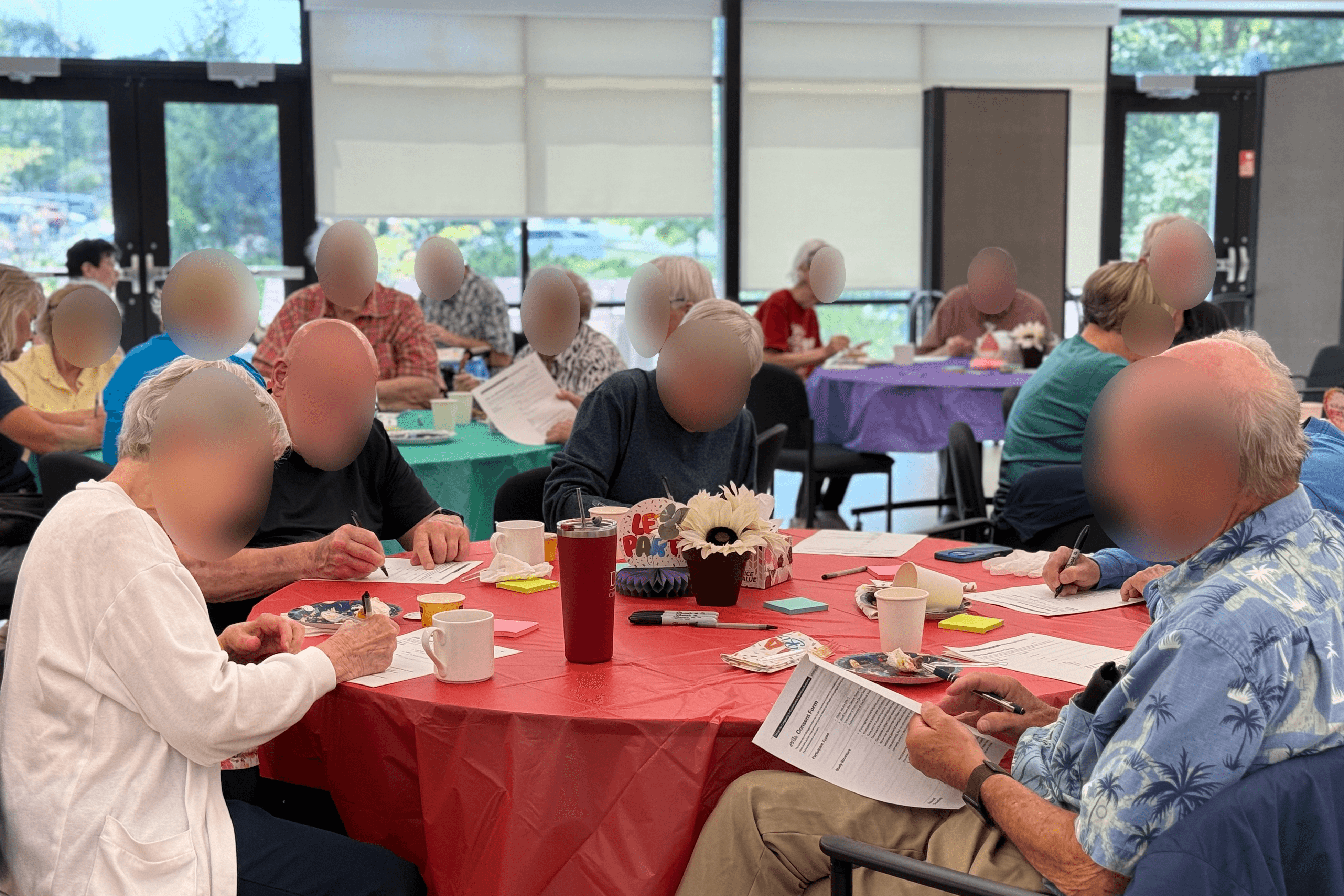
I flew out to Dexter, Michigan to help facilitate the design research workshop. The workshop was an extension of the monthly birthday lunches the senior center hosts, and we were able to survey 40+ participants. A second workshop was hosted the next month and surveyed 15+ participants.

The workshop flow
We created this schedule to give seniors adequate time to both socialize with one another and participate in the activities we had prepared.

user journey

d4l mapping

Take a look at the GoPro footage from the workshop!
design
Designing facilitation materials
I designed a set of facilitation materials for the workshop to introduce our project to participants and to help collect baseline data.


Designing for a new age group
For our facilitation materials we chose physical handouts as opposed to a digital format to help accommodate the technological barrier many seniors face. Designing these materials meant accounting for visual factors I had overlooked before such as text size, contrast, and color.


reflection
Expectations vs. Reality
I learned many lessons from the workshop, some aspects went the way I expected, others didn't. Take a look at my expectations vs. realities.

Gaining access into individuals lives
I learned that seniors love to chat! After directly interacting with the user base, I felt more connected to them and confident in identifying the pain points they face.
synthesis
How we synthesized 100+ sticky notes...
Take a look at the process it took to get from sticky notes to a research paper.

The notes from our workshop and our own comments
I found writing my thoughts and or observations on the sticky notes to be a generative way of thinking and helped me to break out of the mind set of finding one solution and helped me brainstorm many.


Our findings are being published (my very first research paper!)
The long-term vision of this project is to develop and test a scaleable service model for the senior center.
"Community nutrition extends beyond food provision to encompass social relationships physical environments, transportation, material resources, and service infrastructures."
lessons
Many lessons were learned…
Design is the last 10%
Research, ideation, and testing are 90% of the process. Design is the last 10% that articulates all the findings into a cohesive solution.
Stop being so rigid!
Design is subject to change throughout the process. Don't get married to one idea or vision, stay flexible and adapt to new circumstances or problems.
curious for more?
Our research paper is still under review. Please contact me if you want to know more!